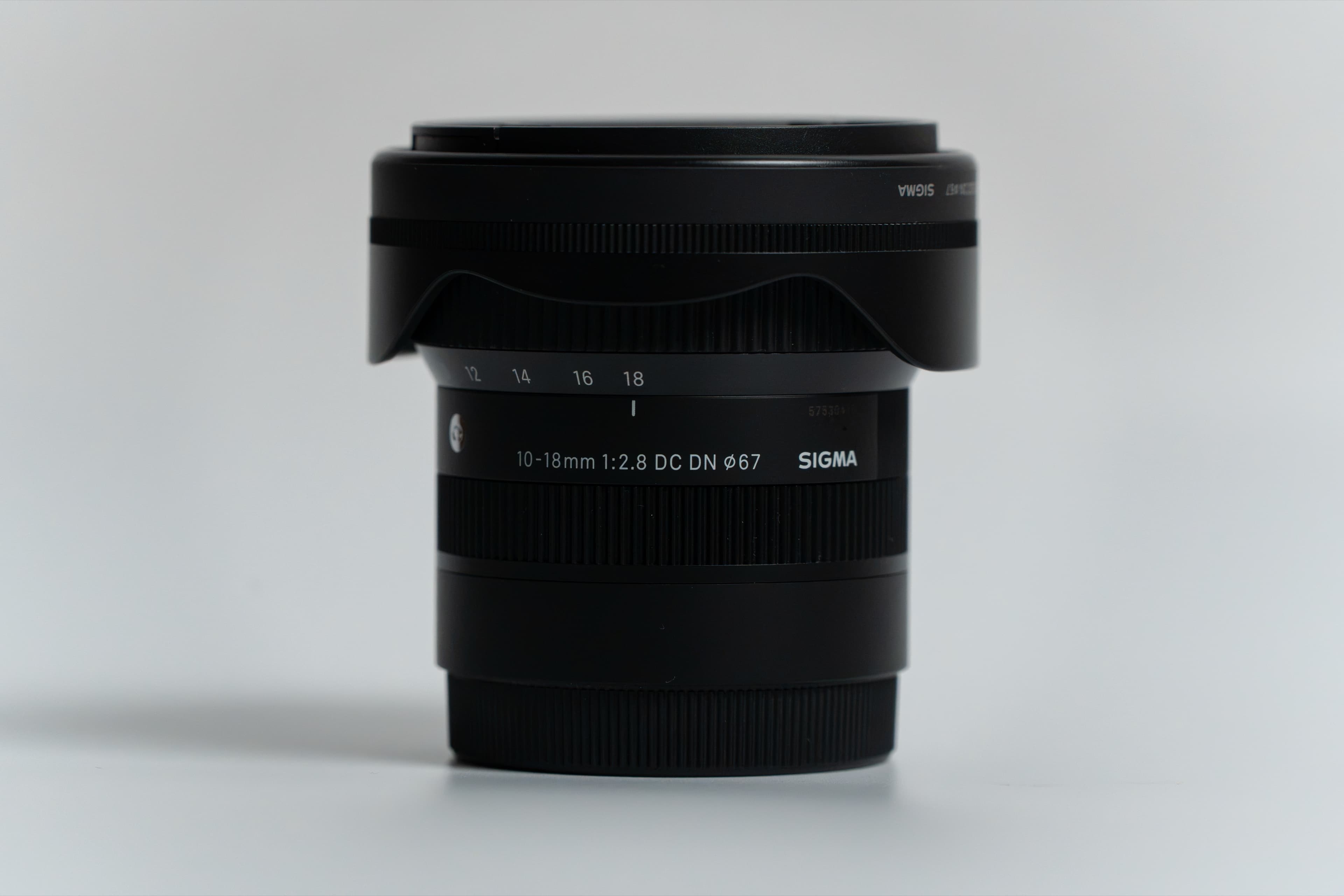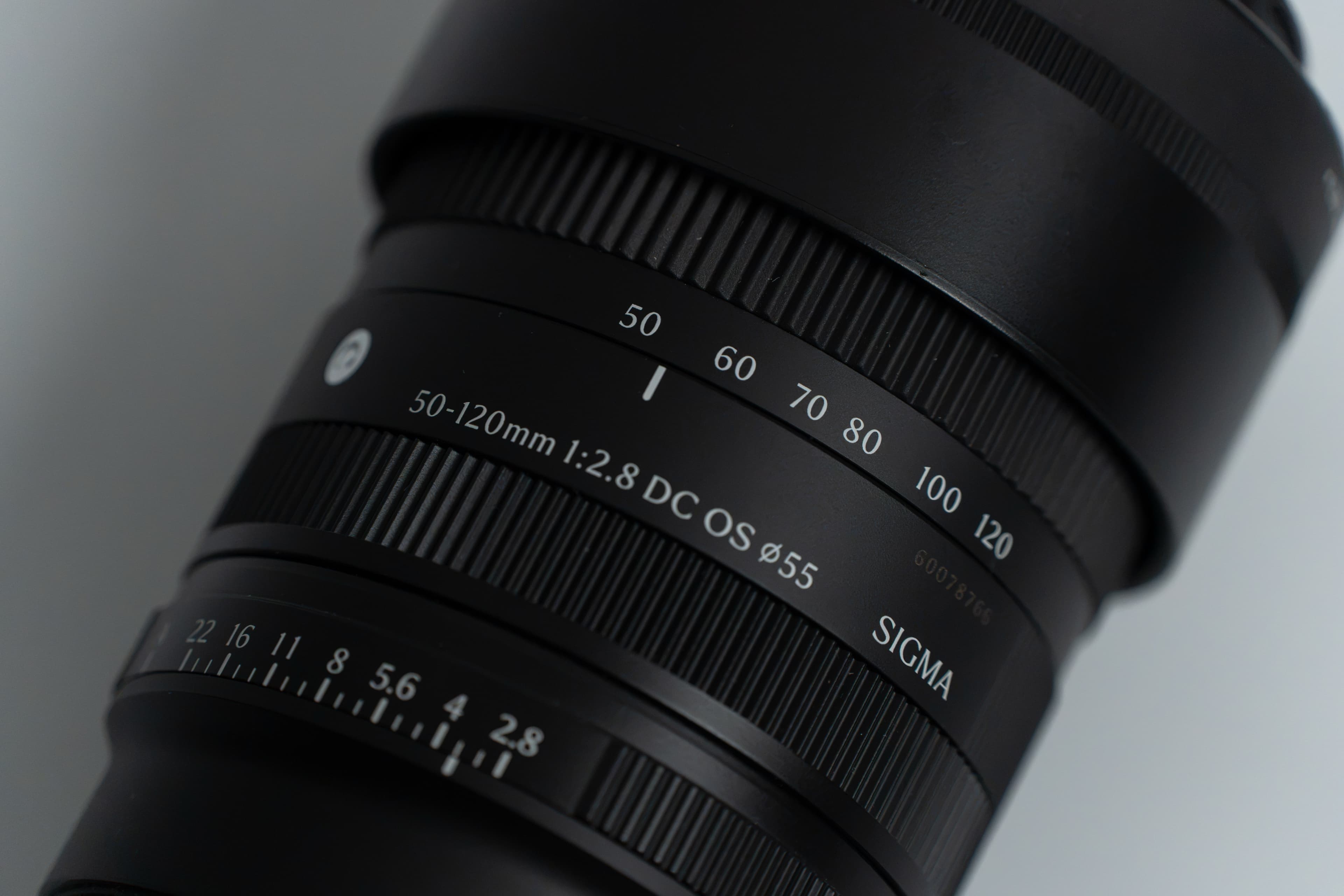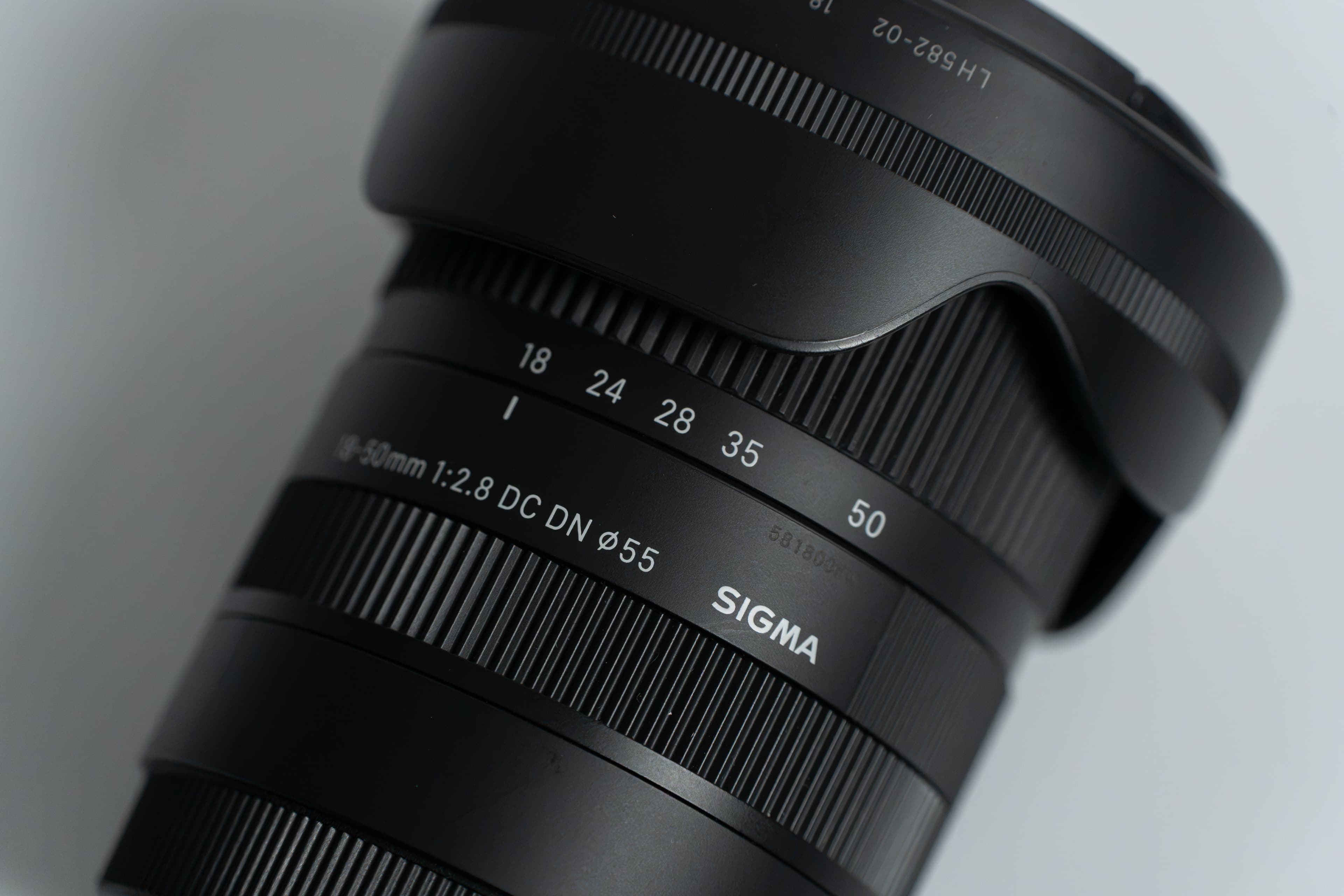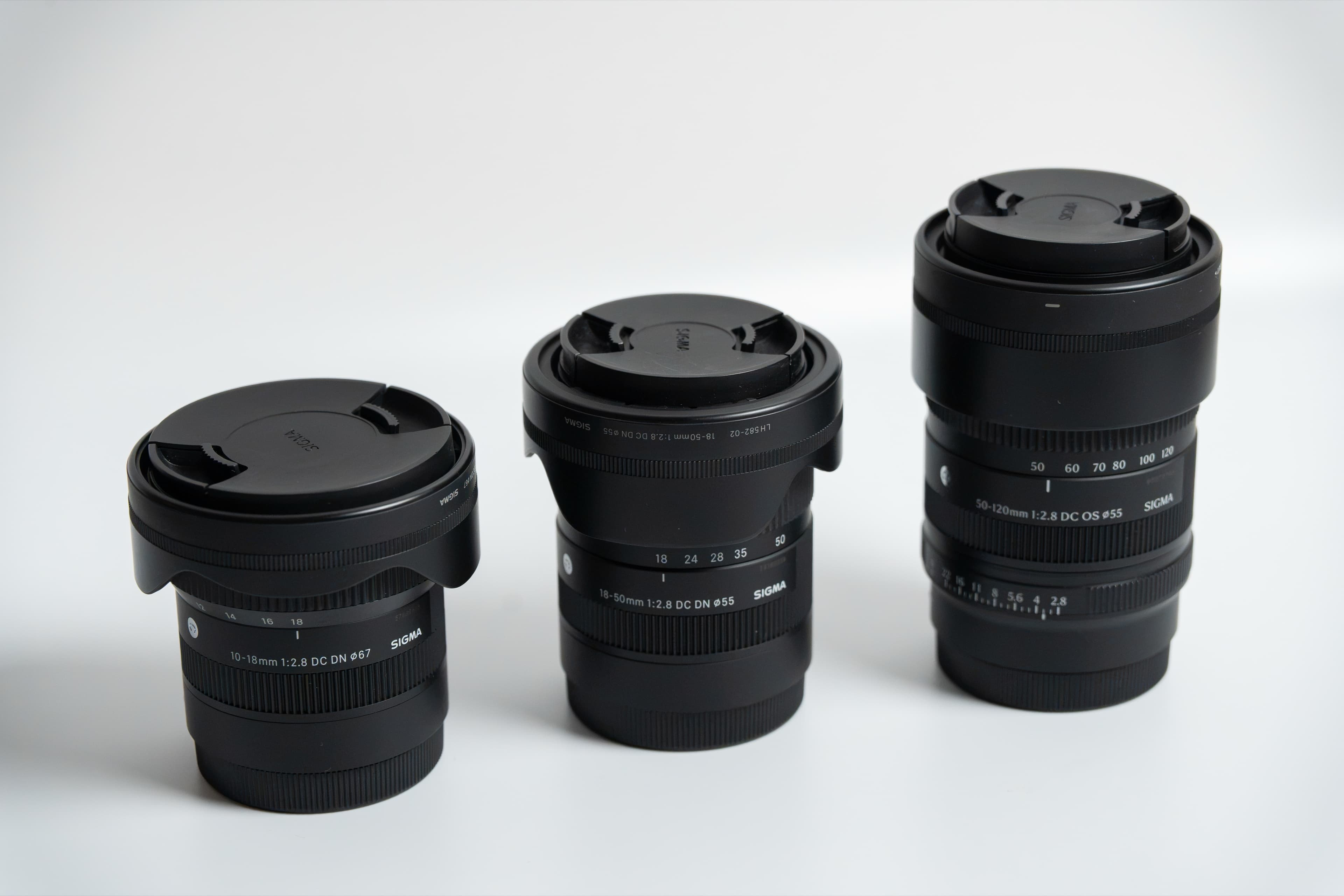
With the arrival of the 50-120mm F2.8 DC OS, SIGMA’s constant F2.8 zooms for APS-C now come as a set of three, from wide-angle to telephoto. It is a “holy trinity” you can build on APS-C too. The focal lengths are 10-18mm, 18-50mm, and 50-120mm, which on E-mount cover 15mm to 180mm in full-frame terms. Whichever lens I put on, it is the same F2.8, and it stays F2.8 even as I zoom, which is reassuring in its own way.
In Seoul, I spent about four days going around shops and street stalls, swapping between the three lenses. My first trip to Okinawa was three days and two nights by rental car, and I split the lenses between two cameras, the α6700 and the α7C II.
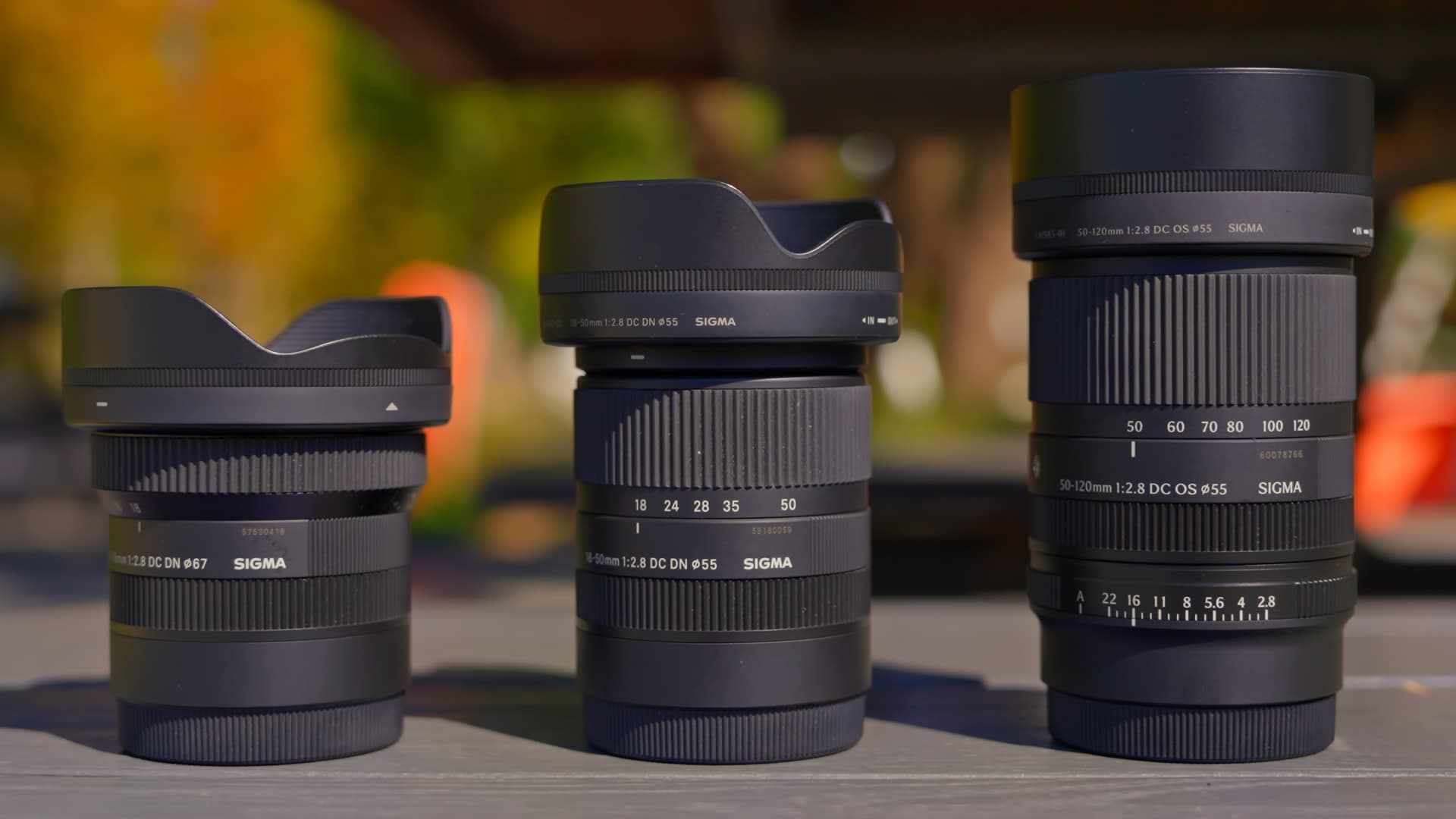
About 15-180mm in full-frame terms for about 935 g: the specs of the three lenses
| 10-18mm F2.8 DC DN | 18-50mm F2.8 DC DN | 50-120mm F2.8 DC OS | |
|---|---|---|---|
| Focal length (full-frame equiv.) | Approx. 15-27mm | Approx. 27-75mm | Approx. 75-180mm |
| Weight (Sony E) | 255g | 290g | 390g |
| Max. diameter × length | φ72.2×64.0mm | φ61.6×76.5mm | φ66.8×99.0mm |
| Minimum focusing distance | 11.6 cm (W) – 19.1 cm (T) | 12.1 cm (W) – 30 cm (T) | 23 cm (W) – 55 cm (T) |
| Filter size | φ67mm | φ55mm | φ55mm |
| In-lens image stabilization | No | No | Yes |
| Aperture ring | No | No | Yes |
Specifications from SIGMA’s official website.
The three together come to about 935 g, under 1 kg. I used to own the FE 70-200mm F2.8 GM OSS II. That one lens weighs over 1 kg, so taking it on a trip took real resolve, and even when I did, I often came home without ever putting it on. Having all three, from wide-angle to telephoto, and still weighing less than that single lens makes a big difference.
Only the 50-120mm has image stabilization and an aperture ring. The filter size is φ55mm on the 18-50mm and 50-120mm, and φ67mm on the 10-18mm alone. If you want to share the same filters across all three, that is the one thing to watch out for.
From 10mm to 120mm, side by side from the same spot
The easiest way to see the difference in angle of view is to line the shots up. By the river at night and on a street by day in Seoul, I swapped between the three lenses and lined up 10mm to 120mm from the same spot.
Along the river at night
At 10mm, the frame takes in the whole river, the lights on the bridge, and the city lights beyond. Zoom in to 120mm (180mm in full-frame terms), and you can crop in tight on just the streams of water from the fountain. Even with the same night view, simply changing lenses changes what the photo is about.
A street by day and the sign on the roof
By day, in front of a popular bakery in Seoul.
At 10mm, the street lined with shops and the blue sky fit into a single frame; at 120mm, you can crop in on just the sign on top of the chimney on the roof. Keep the feel of a place with the wide-angle, and pick out the scenes that define the trip with the telephoto. Being able to switch between the two while traveling is what makes having all three so much fun.
The 10-18mm wide-angle: fitting a wide view into a single frame
I haven’t used wide-angle all that much until now. Even so, a travel photographer I like uses wide-angle zooms really well, and to me, travel photography means a wide-angle zoom. On the α6700, the 10-18mm covers about 15-27mm in full-frame terms. When you usually shoot with a standard zoom, the world you see changes all at once just by swapping lenses.
On my first trip to Okinawa, I could fit the sea, the sky, and the sunset into a single frame. I had brought the 50-120mm telephoto too, but for the wide-open sea, I’m glad I brought a wide-angle. At about 255 g, it was no burden even when carrying two cameras with the α7C II.
At the wide end, it focuses as close as 11.6 cm. Getting close to a little shisa keeps the frame from feeling empty, with a nice touch of blur. The izakaya in Naha was dark inside, so I opened up to F2.8, raised the ISO, and cleaned things up with Lightroom’s noise reduction. As a record of the trip, the photos come out more than clean enough.
These days smartphones have ultra-wide cameras too, and even the standard iPhone goes as wide as the equivalent of 13mm. If you just want to shoot wide on a trip, I think the iPhone’s ultra-wide is enough. If you want to take it a step further from there, a wide-angle zoom is worth bringing along.
The 18-50mm standard zoom: light at about 290 g, with soft rendering
The 18-50mm is the standard zoom that stays on my α6700 most of the time. It covers about 27-75mm in full-frame terms and weighs only about 290 g despite being constant F2.8. Even with the α6700, it comes to about 780 g, and I have never found it a burden, whether hanging from my neck or tucked in a bag.
I bought it before my first trip to Paris. I had heard there were a lot of pickpockets and was a little scared, so I was looking for a lens that wouldn’t stand out but would still let me enjoy taking photos. On my trip to Paris in November 2024, this was almost the only Sony combination I brought.
The rendering is delicate, with soft contrast. At the wide end, it focuses as close as 12.1 cm, so I can get right up to food and flowers. The long end only reaches about 75mm in full-frame terms, but for the way I shoot, that is enough.
Of the three, this is the lens everything else builds on. With the 18-50mm as the base, I add the 10-18mm on days I want to shoot wide, and the 50-120mm on days I want to reach farther or tidy up the background. Right now, that is the way of using them that suits me best.
The 50-120mm telephoto: tidying up the background
The 50-120mm covers about 75-180mm in full-frame terms. At about 390 g, it weighs almost the same as an α6700 body without its battery, and at 99mm long, it is under 10 cm. A telephoto zoom that fits in the same small sling bag as my passport and wallet is something I had long been waiting for.
Of the three, this is the only lens with image stabilization and an aperture ring. When I raise the camera to shoot, I like adjusting ISO and shutter speed with my right hand and the f-number on the lens with my left, so this is something I’m happy to have.
When traveling, people and other tourists often end up in the background. Opening up to F2.8 at telephoto lets me keep just what I want to shoot and tidy up the background. It is also fun to frame hillside neighborhoods and layers of rooftops with telephoto compression, where near and far come together. At the wide end, it focuses as close as 23 cm, and plates and glasses on the table come out with little distortion.
Few smartphones can reach 180mm in full-frame terms optically. The blur of a telephoto lens and its strength in dark places are what make me glad to be shooting with a camera. There are times I want to reach even farther, and then I crop. To me, keeping it this small matters more than a longer reach that would make the lens longer.
I like photos around 50mm, and I enjoy using prime lenses. Picking a prime in your favorite angle of view after a standard zoom is still a good way to choose, I think. But now that light telephoto zooms have arrived, they have become a new option to weigh as well.
Carrying all three
In Seoul, I kept one lens on the camera, one in the sling bag with my valuables, and the third in my tote bag. If I switch which lens goes in the sling bag depending on where I am heading, I can swap it on the spot, standing right where I am, when I find something I want to shoot.
I’m not very fond of changing lenses outdoors. With a big lens, I find it scary to swap without a bench or a table. The 50-120mm has a slim barrel that fits in my hand, so I can change it with confidence even while holding my bag.
In Okinawa, where I got around by car, I brought two cameras: the 10-18mm stayed on the α6700, and the 50-120mm went on the α7C II in S35mm mode. S35mm mode lowers the pixel count, but for keeping a record of a trip, it doesn’t bother me.
We reached the Fukugi tree-lined road around 9 a.m., when there were few people, so I could walk around at an easy pace. I took in the trees stretching ahead wide with the 10-18mm, and a lounging cat from a little way off with the 50-120mm. With the lenses split between two cameras, I only have to switch cameras to suit the scene in front of me.
All three are constant F2.8, covering everything from wide-angle to telephoto. You don’t need all of them at once: you can start with the 18-50mm and add one at a time as you see what you want to shoot. A light “holy trinity” you can rearrange to suit where you are going is now complete on APS-C.