When I pick up my Leica M Monochrom (Typ 246) before heading out, it always has the current Summicron-M 50mm f/2 mounted. This was the first M-series Leica I ever held, back in early 2022. Leica makes cameras that have no color filter and can only shoot in black and white. All they can capture is the tonal range from white to black, and light and shadow.
August Sander’s Portraits at the Entrance of Paris Photo
In November 2024, I took my Leica M Monochrom (Typ 246) to Paris Photo for the first time. When I stepped into the Grand Palais, the whole wall facing the entrance was lined with August Sander’s portraits: 619 prints from People of the 20th Century, his photographs of the people who lived in 20th-century Germany. In this series, he photographed people by occupation and social position, from farmers and craftsmen to artists and city dwellers. Together with the energy of the fair, I felt as if I had been swallowed up by the photographs all at once.
The wall was filled with black-and-white portraits taken by August Sander (1876 – 1964). Even without color, a photograph can record the era people lived in this powerfully. That power was overwhelming.
There were many other black-and-white photographs at Paris Photo as well. Standing face to face with the work of so many great masters was a luxurious time.
Someday, I want to be able to take photographs that reach people even in black and white.
Focusing by Aligning a Double Image: The Joy of a Rangefinder
The Leica M Monochrom (Typ 246) is a rangefinder camera from the Leica M system. You focus by turning the focus ring until the double image in the center of the viewfinder merges into one. By design, there is no autofocus. You press the shutter the moment the two offset images line up perfectly. That motion is the greatest joy of shooting with an M-series Leica.
Another appeal of the rangefinder is that you can see beyond the frame. The viewfinder is a clear window of glass, with bright-line frames that show what will be in the picture (the angle of view). Because it is clear glass, you can also see outside the area the lens captures. You can see someone walking toward the 50mm frame from outside it, so you can wait for them to step into the frame before pressing the shutter. It is a fundamentally different way of seeing a scene from a viewfinder that shows only what will be captured.
Both the act of focusing and the time spent shooting while watching beyond the frame feel deeper the more I shoot. With a viewfinder magnification of 0.68x, close to life size, you can even shoot with both eyes open. You can take in the atmosphere of the place with your own eyes and press the shutter as an extension of that.
Seeing Only Light and Form with the Black-and-White-Only Leica M Monochrom (Typ 246)
Leica’s monochrome-only cameras began with the original M Monochrom in 2012. The first model used a CCD sensor, and the APO-Summicron-M 50mm f/2 ASPH. was released the same year. The Leica M Monochrom (Typ 246) arrived in 2015 as the second generation, with the sensor changed to CMOS. Since then, the M10 Monochrom and M11 Monochrom have followed, and Leica continues to make monochrome-only M cameras.
Because the sensor has no color filter, each pixel records only the brightness of the light as it is, without separating colors. That gives the images a high sense of resolution. It shoots only in black and white from the start, and you cannot turn the images back into color later.
It is a camera with a constraint, but shooting with it never feels confining. My eyes go to light and shadow, form and texture. Being able to press the shutter without relying on color is what makes carrying this camera so comfortable. That holds true for everyday snapshots and for making work for exhibitions alike.
When I exhibited my photographs at Kohaze Coffee, I also printed images taken with the Leica M Monochrom (Typ 246). I used A3 paper such as Epson Crispia and Pictorico Pro Semi Gloss Paper. Every print made me feel the depth of black and white.
To convey something in black and white, you can only show it through light and composition. That is what makes it difficult, and what makes it interesting. The texture of the blacks and the texture of the paper also change the impression a photograph leaves.
Sample Photos: Paris and Everyday Snapshots
Paris, November 2024
Everyday Snapshots
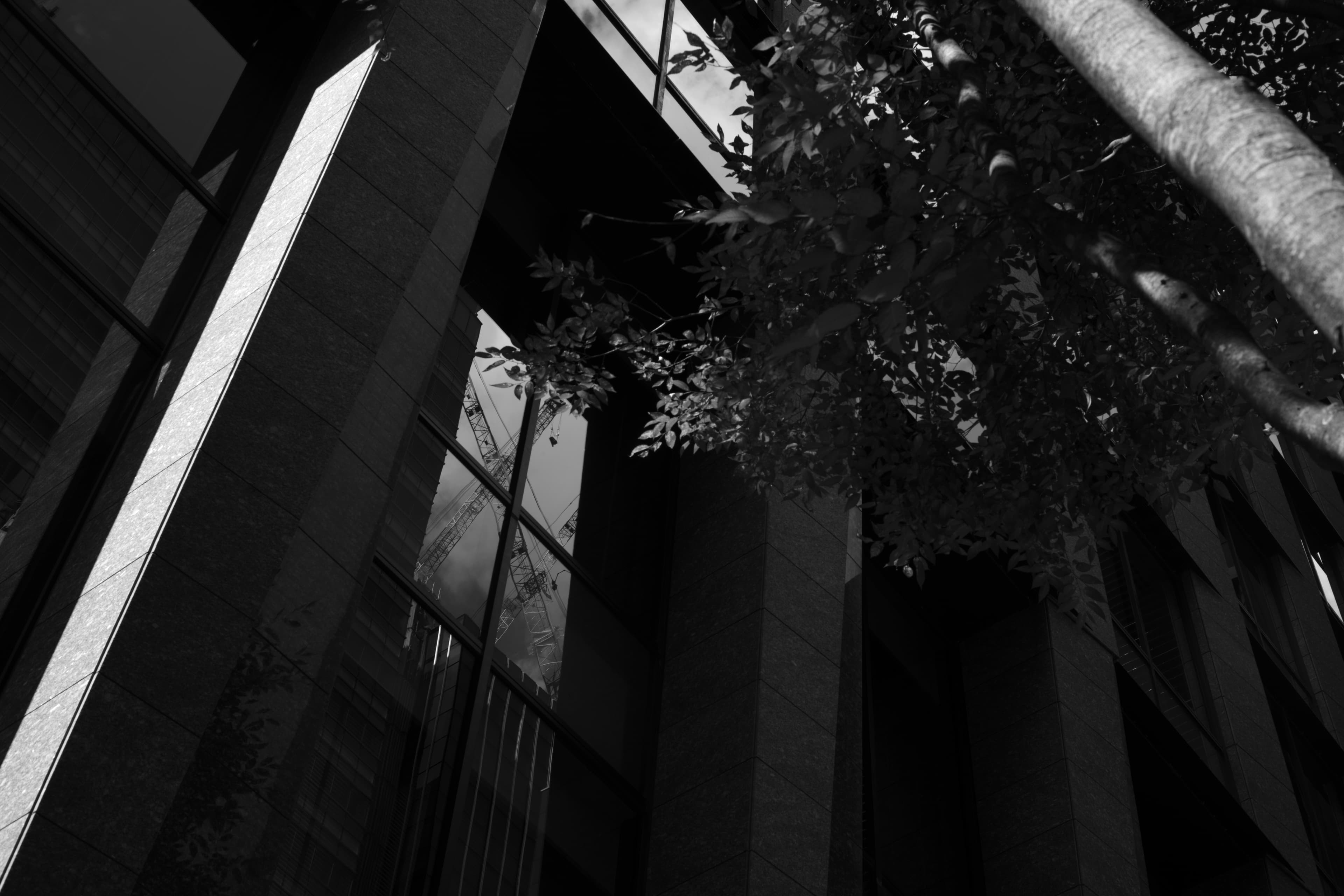
All photos: Leica M Monochrom (Typ 246) / Summicron-M 50mm f/2
Photography began in black and white. Even now that shooting in color is the norm, Leica keeps making M cameras that can only shoot in black and white. The Sander portraits I saw at the entrance of Paris Photo had no color, yet they captured the people who lived there and their time.
With the first M-series Leica I ever held, I want to one day capture that much in my own photographs, too. Today, again, I head out with my Leica M Monochrom (Typ 246) and its Summicron.
How much can a photograph without color convey? Enjoying that constraint as I go.
- Camera: Leica M Monochrom (Typ 246)
- Lens: Summicron-M 50mm f/2 (current version, 6-bit)